
Contents
The Rise of Visual Learning in 2026 Key Benefits of Animation for E-learning (Engagement, Retention, Flexibility) Types of Educational Videos (Tutorials, Scenario-based, Infographic, Process & Safety) How to Implement Animation in Corporate Training Future Trends. VR and Interactive E-learning FAQ17 min read
The online education market has undergone fundamental changes in recent years. If earlier most courses consisted of textual materials and presentations, today video has become the key format for transmitting knowledge. That is the reason educational animation is becoming more popular in university curricula, edtech platforms, and corporate training systems.
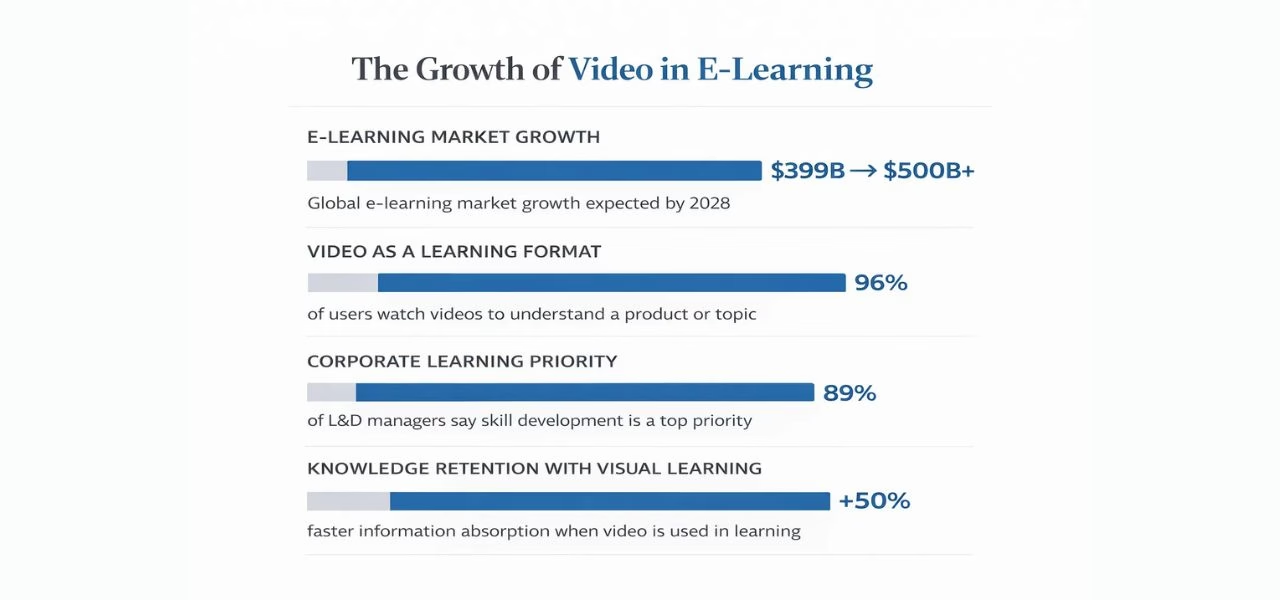
The study conducted by Research and Markets shows that the global e-learning market in 2025 exceeded $399 billion. By 2028, growth is expected to surpass $500 billion. Another study from Wyzowl Video Marketing Statistics 2025 demonstrates that 96% of users watch explainers to understand a product or a complex topic. Educational videos rank among the top three most effective formats for conveying information.
This directly influences the development of e-learning video production. Another important factor is the growth of corporate training. According to the LinkedIn Workplace Learning Report, over 89% of L&D managers consider skills development a key business priority. Companies are investing in scalable training formats, and training video animation is becoming one of the most effective tools for this.
In conditions of information overload, knowledge retention is becoming the key indicator of training effectiveness. This is a person’s ability to remember and apply information. That is why educational animation is becoming more prevalent in explaining complex topics.
Below is an example of educational animation from the Kurzgesagt channel. Here, complex scientific concepts are explained through visual metaphors and animated graphics.
yt_iframe
It is here that educational animation demonstrates significantly better results compared to textual materials. Visual explanation activates several perception channels at the same time. This is exactly what increases the depth of understanding of the topic.
Richard E. Mayer. Cognitive science researcher:
“People learn more deeply from words and pictures than from words alone.”
The Rise of Visual Learning in 2026
A big factor contributing to the growing appeal of educational animation is the fundamental change in the way information is perceived. Modern users better perceive information through video, interactive elements, and short visual formats. This approach is consistent with the principles of visual learning. They are actively applied in modern instructional design.
Approximately 65% of people absorb information better through visual content. What this means is simply this – graphics, diagrams, animation, and visual metaphors can dramatically speed up the comprehension of complex subjects. That is why educational platforms are actively integrating e-learning video production into their curricula.
Another important trend is microlearning. Instead of long lectures, modern courses are broken into short modules lasting approximately 3 to 7 minutes each. Each module explains one specific topic or skill. This format better matches user behavior in the digital environment and helps increase knowledge retention.
In this format, training video animation works especially effectively. Short animated modules allow:
Quickly explaining complex processes
Demonstrating abstract concepts
Visualizing statistics and data
Creating understandable learning scenarios
The use of video in training can increase the speed of information absorption by up to 50%. Interactive elements further increase user engagement.
Sal Khan. Founder of Khan Academy:
“Video is a powerful tool because it replicates what a good teacher does: it combines explanation, demonstration, and the right pace.”
In the context of edtech trends 2026, educational animation also plays an important role in establishing scalable learning systems. Online courses, internal corporate platforms, and global educational programs need visual content. The one that can be easily adapted to different languages, cultures, and markets. That is why educational animation becomes a universal format. By changing the voiceover or text elements, the same video material can be used in different countries.
As a result, visual learning ceases to be just a trend. It becomes the basic standard of modern e-learning.
One of the leaders in creating educational animation is TED-Ed. It is an educational initiative of TED. They specialize in short animated video lessons for schoolchildren, students, and a wide audience. TED-Ed regularly develops educational animations. These explain complex topics in simple and visual language, using bright visual metaphors and interactive elements.
Some examples:
- 5 myths about Vikings that everyone believes – Stephanie H. Smith
The video debunks common myths about Vikings and shows how animation helps to better understand historical facts.
yt_iframe
- What happens when you break a bone? – Gurpreet Baht and Natalie Pang
The educational video explains the biological processes of bone recovery after a fracture.
yt_iframe
- Was Alexander the Great really that great? – Stephanie Honchell Smith
The animated lesson analyzes the life and achievements of Alexander the Great. Viewers better remember historical events through visualization and narrative scenarios.
yt_iframe
These examples boil down to one thing – educational animation is able to make the learning process more effective and accessible.
Key Benefits of Animation for E-learning (Engagement, Retention, Flexibility)
One of the main reasons why educational animation is actively used in modern learning systems is the combination of several key effectiveness factors. High level of engagement, improved information retention, and flexibility in content use.
Animation allows the creation of a dynamic visual scenario. Here the information is presented gradually, structured, and logically. This approach corresponds to the principles of instructional design. The learning material is delivered in small, understandable blocks.
Main advantages of educational animation in learning
1. Higher level of engagement (Engagement) Animated content naturally attracts the user’s attention. Motion, scene changes, and visual metaphors create the effect of a story. This significantly increases interest in the material. That is why training video animation is often used in onboarding programs, product training, or internal company courses.
2. Improvement of knowledge retention One of the main problems of online learning is the rapid forgetting of information. When text is combined with graphics, motion, and voice explanation, several information perception channels are activated. As a result, knowledge retention significantly increases and complex concepts become clearer.
3. Flexibility and scalability of learning content Another important advantage of e-learning video production is the ability to easily adapt video for different audiences, languages, or markets. For example, one training video animation can be used to train teams in different countries. Only the voiceover or text elements need to be changed.
4. Effectiveness for microlearning One of the key edtech trends 2026 is microlearning — short learning modules lasting approximately a few minutes. Animation is ideal for this format. Since it allows quickly explaining one specific idea while maintaining the user’s focus and increasing learning effectiveness.
Types of Educational Videos (Tutorials, Scenario-based, Infographic, Process & Safety)
Educational animation can be classified by format and goals. Each type of video has its advantages and application features. Especially in corporate and online courses:
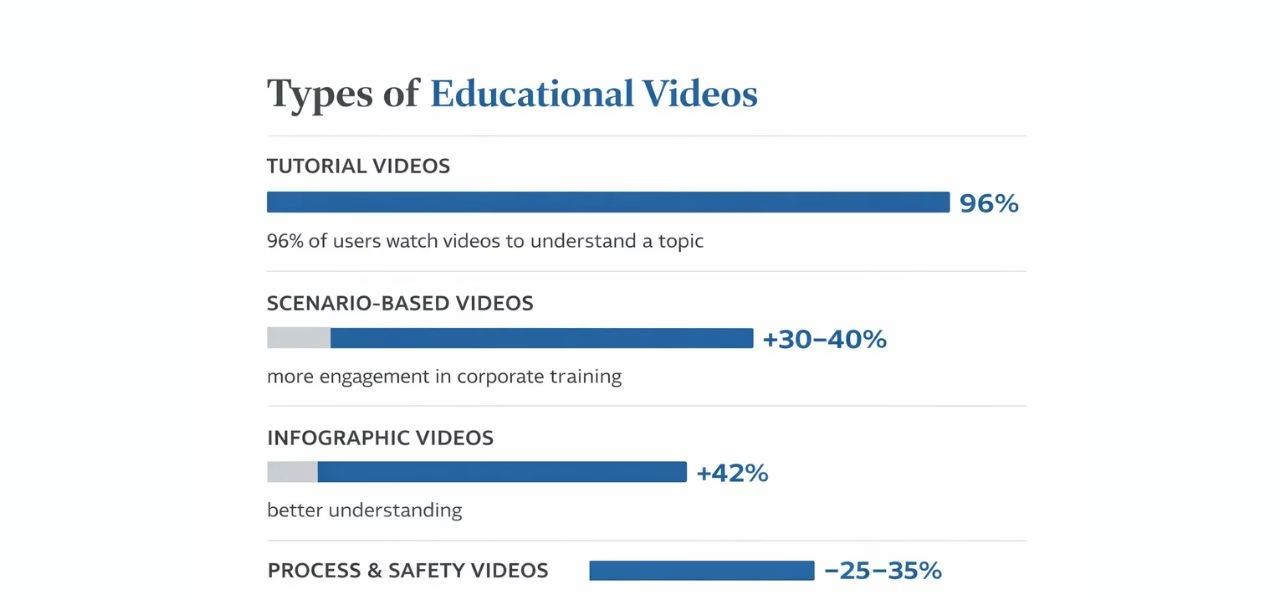
1. Tutorial Videos. Short educational videos. They explain a specific topic or skill.
yt_iframe
Tutorial videos are a key format for fast and effective learning.
2. Scenario-Based Videos. Videos with scenarios of real situations. Users can see the practical application of knowledge.
yt_iframe
Such modules are especially effective in corporate training due to their ability to increase engagement and help employees better remember actions in various work situations.
3. Infographic Videos. Animated charts and diagrams. They visualize statistics or processes.
yt_iframe
Research shows that understanding of material increases when complex data is presented in the form of interactive visual stories.
4. Process & Safety Videos. Educational videos for demonstrating work processes, safety procedures, and company standards.
yt_iframe
The use of animation allows significantly reducing employee errors. Because users see the sequence of actions in a safe and visual format.
This division helps platforms and companies choose the most effective format for a specific learning goal. Data visualization, interactivity, and the ability to easily adapt content make educational animation a universal tool for modern e-learning.
How to Implement Animation in Corporate Training
Animation without a clear strategy can be expensive and ineffective. It is, therefore, worth using a proven workflow.
1. Defining goals and audience
Before starting production, the following should be clearly defined:
Main learning goal (skills improvement, compliance, safety)
Target audience (level of experience, role in the company, language)
Video format and duration (microlearning – 3 to 7 minutes, full modules – up to 15 minutes)
Clear definition of goal and audience enables to optimize the script and increase the effectiveness of knowledge retention.
2. Script & Storyboard
The script underlies any educational video. It should include:
Problem or situation that needs to be solved
Solution or sequence of actions
Key messages that the user should remember
Script writing is followed by creation of a storyboard. Of the so-called frame-by-frame visualization. This helps:
Reduce edits at later stages
Check the logic of material presentation
Ensure consistency of style and structure
3. Production (Animation)
Production stage creates animation:
2D or 3D characters and graphics
Motion graphics to enhance key data and processes
Interactive elements. Interactive questions, choice of actions in scenarios
This stage enables to turn the concept and script into understandable and effective learning content.
4. Delivery & Evaluation
Now that the video is created, it is important to deliver it correctly and evaluate its effectiveness:
Use of LMS or corporate portal for access
Engagement analytics. Completion rate, views, interactive answers
Adjustment of material based on data to increase effectiveness
This approach guarantees that the training video animation contributes to real knowledge absorption.
Future Trends. VR and Interactive E-learning
E-learning video production has been actively integrating new technologies throughout 2026. These include, in particular, VR, AR, and interactive elements. The approach to corporate and educational learning is changing. With interactive scenarios at hand, users can participate in the process, make decisions, and immediately see consequences.
“Technology will never replace great teachers, but technology in the hands of great teachers is transformational.” – George Couros
yt_iframe
Main trends:
VR and AR integration. Immersive simulations improve understanding of complex processes and procedures. Modeling of laboratory experiments or industrial operations in virtual environment, for example, enables to practice skills safely.
Interactive videos. The user can choose the plot direction or answer questions right during viewing.
Personalization of learning. Platform analytics enables to adapt content to individual needs, creating more effective training video animation modules.
Microlearning in VR/AR. A combination of short interactive modules and animation promotes quick absorption of key knowledge. This combination corresponds to modern requirements of corporate learning.
The VR market for corporate learning undergoes constant growth. Interactive videos are used by a significant share of corporate learning platforms in the USA and Europe. This confirms that integration of new technologies into educational animation makes it to the standard for effective e-learning.
So
Educational animation in 2026 is becoming the key tool of e-learning. It combines visual learning, interactivity, and microlearning. The use of animation increases engagement, improves knowledge retention, and makes learning more flexible and personalized. Thanks to the integration of VR and interactive elements, new opportunities emerge for corporate and educational programs. The learning process is now more effective, safe, and modern than ever before.
FAQ
What is educational animation?
Animation created for teaching and explanation of complex concepts through visualization.
How does animation improve learning?
It increases remembering, makes information visual and understandable.
Why is video effective for training?
It combines sound and image, accelerates perception and retention of information.
How long should an e-learning video be?
Optimally 3-7 minutes. Short segments are easier to absorb.