Definition
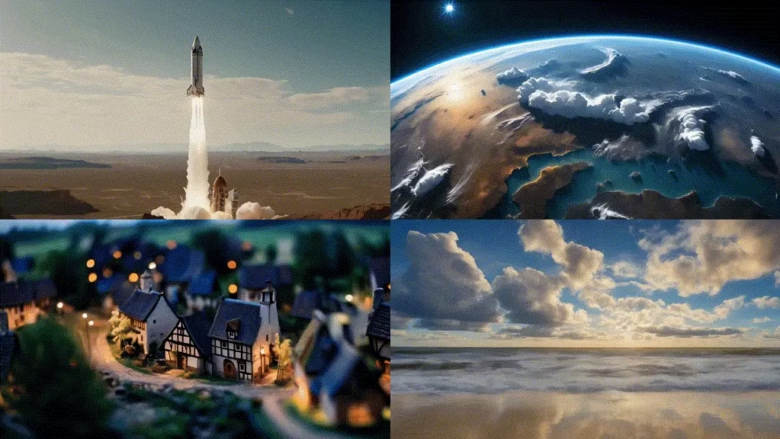
Sora is a powerful video generation model developed by OpenAI and introduced in 2024. It combines diffusion modeling with transformer architecture, enabling the creation of videos up to 60 seconds long with a high degree of visual realism. Unlike earlier models, Sora doesn’t just generate isolated frames – it builds coherent scenes with logical dynamics, realistic motion physics, and preserved spatial-temporal context.
The model understands both realistic prompts (“a man walking through a snowy forest”) and abstract ones (“a city made of jelly melting under the sun”), generating full-fledged visual narratives from them.
Uses and Benefits
Sora is reshaping how video content is created across business, creativity, and education. In marketing, it enables the production of promotional videos within minutes. For video production, it serves as a tool for scene previsualization or special effects generation. Educators can turn abstract ideas into visual explanations, while content creators can produce videos without filming, editing, or actors.
Its key advantage lies in its deep grasp of physical logic: objects fall, reflect, and interact as they would in the real world. This makes the videos not just visually appealing, but also believable.
Key Features
- Generates videos up to 60 seconds long
- Realistic physics, spatial reasoning, and action logic
- Supports both text and image-based prompts
- Maintains coherence and internal logic within scenes
- Wide visual range – from photorealism to stylized animation
Conclusion
Sora is a breakthrough technology that blurs the line between imagination and video. It not only streamlines content creation but redefines video production itself – making it faster, more flexible, accessible, and visually compelling. While the model is not yet publicly available, its potential already points toward a future where ideas can instantly become visual reality.