
Contents
Creating a Flawless First Impression Visualizing Software Features Without the Boredom Measuring the Link Between Video and Retention Best Practices for In-App Video Placement Onboarding as the Speed of Product Understanding FAQ12 min read
Up to 30%+ churn reduction in some SaaS onboarding case studies
Onboarding today has become one of the most important elements of a customer retention strategy. Instead of long instructions, SaaS brands are increasingly employing user onboarding video and short animated explainers that help guide a person to the first “aha moment” faster.
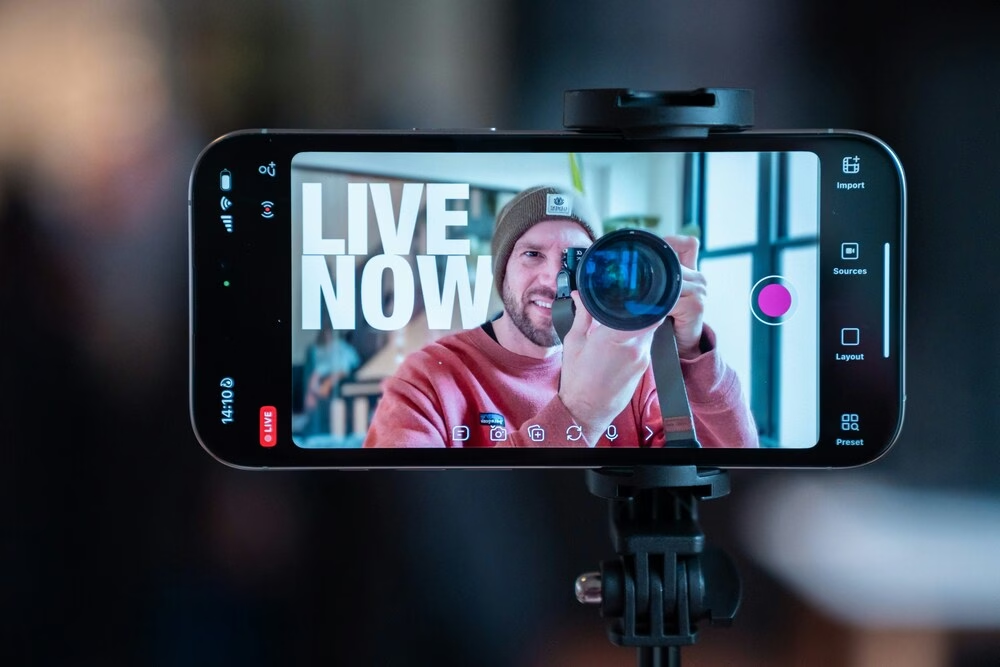
In a number of SaaS case studies, onboarding videos are associated with a decrease in 30-day churn. In some cases, up to 30% compared to products without video
Companies note an improvement in retention in the first 30 days after the implementation of animated onboarding flows
Optimization of the onboarding experience in B2B SaaS cases often correlates with an increase in activation rate and lifetime value
The greatest impact is usually observed at the stage of the first user session and time-to-value
But the main question sounds different.
Why are users ready to spend hours on TikTok or YouTube, but leave a SaaS platform after a few minutes of interaction?
The answer is often connected not with the product itself, but with how quickly the service explains its value.
As Steve Krug noted in the book Don’t Make Me Think:
“If something requires huge investment of time – or looks like it will – it’s less likely to be used.”
This is exactly where SaaS onboarding animation begins to work as a friction reduction tool.
Our experience in creating SaaS onboarding animations shows that video works as a tool for forming the correct mental model even before the first interaction with the interface.

Creating a Flawless First Impression
Often, a user decides whether they will stay in the product even before they have time to test its main features. If onboarding looks complex or overloaded, the risk of early-stage churn increases significantly.
That is why modern SaaS platforms are increasingly actively resorting to user onboarding video as part of the initial product experience. Video and animation help visually explain the product and make the first steps in the service more intuitive.
This is especially vital for complex products with a large number of features. Instead of long instructions or multi-level tooltip scenarios, companies often switch to short animated onboarding sequences or demonstrations. They show key product use cases.
This is clearly visible in modern videos of large technology companies.
Slack demonstrates onboarding through the integration of the product into a real workflow. In the video, the user sees how Slackbot helps navigate teamwork and automate part of the interactions right in the interface.
yt_iframe
Canva uses a different approach. The emphasis is on the result. In the video, the product is shown through the idea of quickly creating a design from ready-made templates. This highlights the simplicity of getting started with the platform.
yt_iframe
Google, in the presentation of Gemini Omni, demonstrates a new approach to interacting with the product. The user interacts with the system through natural language and multimodal requests. This shows the direction of onboarding development towards a more intuitive interaction without classic instructions.
yt_iframe
Visualizing Software Features Without the Boredom
The problem with SaaS onboarding is often in the method of its explanation. A user enters a service without context and has no time to figure out the interface through text instructions.
Therefore, animated onboarding videos and visual demos are used as a way to immediately show the result of using the product.
In Google Flow and Gemini Omni, the user interacts with an AI agent that helps create and edit content in real time. This shifts onboarding into the format of interactive work with the product instead of classic learning.
yt_iframe
In a fintech demo for IbanFirst, a complex service is explained through a short use case scenario. The process and result are shown without technical load.
yt_iframe
Skybeam demonstrates the product through a simple visual scenario of the platform’s operation. The user immediately understands the logic of the service and its result.
yt_iframe
As Don Norman noted in the book The Design of Everyday Things:
“The real problem with the interface is that it is not the interface – it is the lack of a good conceptual model.”
Measuring the Link Between Video and Retention
The impact of onboarding videos and visual demos on SaaS products is best seen in user behavioral metrics. It is precisely at the stage of the first sessions that the key connection between understanding the product and subsequent activation is formed.
According to HubSpot, video is one of the most effective formats for explaining products and significantly affects how users perceive information about a service. Especially in complex digital products.
Typical regularities:
Users who quickly pass through the onboarding flow more often return to the product in the following days
Products with a visual explanation of features reduce dependence on text documentation
Integration of video or interactive demos shortens the time to the first user action
Complex interfaces without a clear onboarding have a higher early-stage churn
In addition, it is worth highlighting the role of product understanding speed. This is the speed with which a user forms a mental model of the product. The faster this happens, the higher the probability that the user will transition to regular use.
In this context, video also performs a structural function. It reduces the number of steps between the first login to the product and the first real action.
It is also noteworthy that onboarding videos affect in combination with UX:
Product tour determines the logic of the first steps
Feature adoption depends on whether users understood the features from the first contact
Friction reduction directly affects the completion of onboarding
Lifetime value increases if the user quickly sees the value of the product and returns to it
Best Practices for In-App Video Placement
The effectiveness of a SaaS onboarding animation is also determined by where exactly the user sees it. In modern products, onboarding is gradually shifting from separate tutorial screens into the internal context of the interface.
The most effective approach today is contextual onboarding, i.e. when a video or short animation appears exactly at the moment of using a feature. This reduces the need for long instructions and shortens the path to the first action.
In real SaaS products, this is implemented through different models:
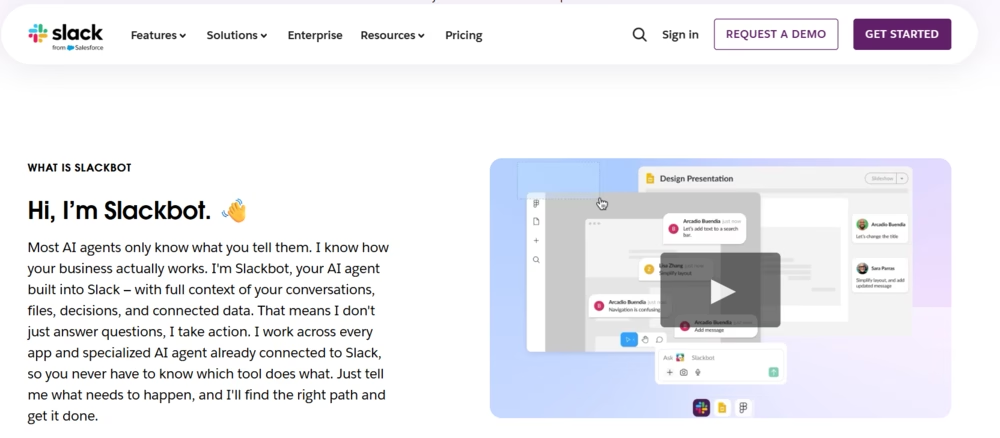
Slack uses onboarding as part of the interaction with the product itself. The user immediately works in the workspace, and Slackbot accompanies them through tips and contextual actions within the interface.
yt_iframe
Notion showcases how modern SaaS onboarding is shifting toward immediate product understanding. In the “Custom Agents” video, users are introduced to the platform through real automation scenarios and AI-powered workflows instead of lengthy interface explanations.
This approach reduces friction and helps users quickly understand the practical value of the product from the very first interaction.
yt_iframe
From these examples, practical principles of video placement in SaaS can be highlighted:
The video should appear at the moment of the first interaction with a feature
Onboarding is more effective when it is integrated into the product
Short demonstrations work better than long explanations
The user must immediately see the result
Onboarding as the Speed of Product Understanding
SaaS is gradually transitioning from onboarding as a separate stage to instant product understanding. The user does not want to learn. They want to see value immediately.
The speed of forming a mental model becomes a key factor in activation and retention.
Animated onboarding videos reduce the cognitive barrier and allow the user to understand a complex product from the first contact.
At Darvideo, we see that the most effective SaaS onboarding solutions today are built around the speed of understanding. And it is precisely this speed that increasingly determines whether the user will stay in the product.
FAQ
What is an onboarding video?
It is a short video that shows new users how the product works and what value it gives from the first minutes.
How to reduce SaaS churn?
You can reduce churn through the rapid delivery of product value and shortening the time to the first benefit (time-to-value).
Best length for product tours?
The best length is 30-90 seconds or several short scenes that explain a key action without overload.
How to welcome new users?
Through a simple onboarding flow. A short welcome, showing the main value of the product, and the first quick successful experience.