Contents
Adding a Human Touch to Digital Stories Technical Basics: Motion Tracking and Overlays How do key elements of hybrid compositing work Use Cases: Corporate Interviews with Data Viz Creative Freedom: Breaking the Reality Barrier Conclusion FAQ10 min read
In 1988, the movie Who Framed Roger Rabbit showed that animation and a real camera can exist in the same space so naturally that the viewer stops noticing the boundary between them.
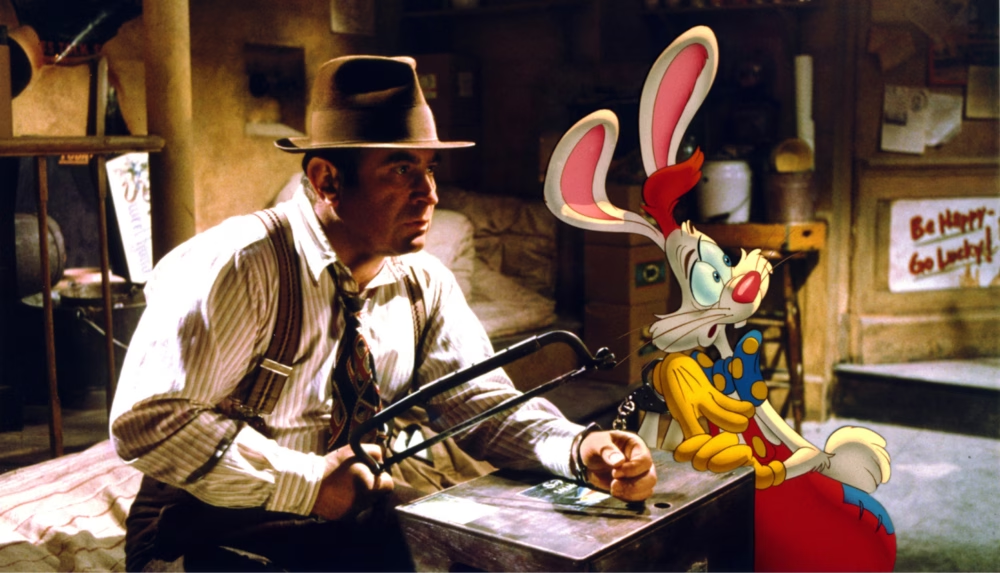
The film received four Academy Awards, including awards for visual effects, which for that time became an almost revolutionary signal for the entire industry.
Almost forty years later, this very same principle became the foundation of modern hybrid video production. Only now, instead of cartoon characters, interface graphics, animated typography, vfx, and digital overlays appear in the frame.
yt_iframe
Why does ordinary video today increasingly look not alive enough for the digital audience?
Perhaps the reason is that the modern viewer perceives dozens of interfaces simultaneously every day. Notifications, floating text, captions, maps, dashboards, and digital overlays. Reality itself began to behave like a screen. This is exactly why hybrid content is perceived so naturally today. It simply speaks the language of the modern digital environment.
Genndy Tartakovsky:
“I don’t want to do animation to mimic reality. I want to push reality.”
This is exactly what hybrid video production does today.
Adding a Human Touch to Digital Stories
Precisely because video has become so saturated with graphics, interfaces, and fast editing, it gradually began to require a counterweight. Something maximally simple and human inside a complex visual system.
This is clearly visible even in how the viewer’s behavior is changing. Research of recent years records several stable patterns in video perception:
91% of marketers utilize video as a key marketing tool in their strategies
Short-form video is the most sought-after format and is among the top ROI formats
51% of marketers consider 30-60 seconds to be the optimal video duration for effective communication
91% of users prefer videos shorter than 2 minutes for quick information perception
70% of users resort to short videos for quick understanding of a product or an idea
The first 5 seconds of a video critically determine whether the viewer will stay or close the content
A bright example of such an approach is Apple with their holiday film “A Critter Carol”.
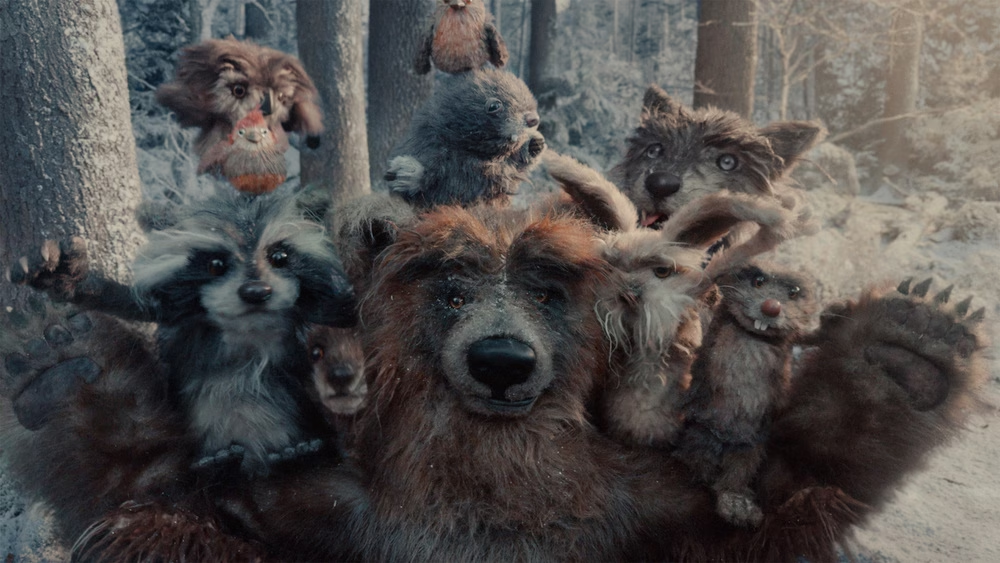
Live action scenes are combined with hand-crafted puppet characters and practical effects that are integrated into a real forest setup. Instead of full digital animation, Apple places emphasis on the physical presence of objects in the frame. This creates that very same effect of hybrid video production. The digital and real world complement each other.
yt_iframe
Technical Basics: Motion Tracking and Overlays
When hybrid video moves from an idea to real production, the most interesting part begins in how it clings to the real world. This is exactly where motion tracking comes to the fore. This technology allows digital elements to follow the movement of the camera or objects in the frame.
Simply put, the camera becomes a coordinate system to which graphics, text, UI elements, or even full-fledged 3D objects are attached.
How do key elements of hybrid compositing work
| Element | What it does | How it looks in the frame |
|---|---|---|
| Motion tracking | Tracks the movement of the camera or an object | Graphics stick to the movement of a person or a scene |
| Matchmoving | Recreates camera movement in a 3D environment | 3D objects move synchronously with live action |
| Overlay graphics | Adds 2D, 3D elements on top of the video | Text, UI, icons, tips in real space |
| Compositing | Combines all layers into one frame | Real video and graphics look like a single image |
| VFX integration | Adds effects into physical space | Light, particles, deformations, interaction with objects |
In modern hybrid video production, these tools almost never work separately. One simple frame with a person walking down the street can contain tracking, matchmoving, and overlay graphics all at once. All this looks like a natural part of the scene.
A bright example of such an approach is “Weekend Characters” (Kensington Market).
yt_iframe
In this project, live action shooting in a real urban environment is combined with animated characters that exist right in the location.
As a result, even complex data or interfaces stop looking like a separate layer. They become a part of the space in which a person exists.
Use Cases: Corporate Interviews with Data Viz
In corporate video, hybrid format manifests itself most practically. Where there is a need to explain complex things simply, but without simplifying the core essence itself. This is exactly why the classic interview is gradually transforming. It becomes a system where speech and data work simultaneously.
In modern corporate hybrid video, several basic levels of visualization can be distinguished:
Human layer. A real person creating trust
Data layer. Graphs, numbers, trends, analytics explaining the context
Motion layer. Animated transitions connecting thoughts into a visual flow
System layer. UI, diagrams, processes, or abstract models showing how it works
It is precisely the combination of these layers that turns an ordinary interview into a hybrid storytelling system.
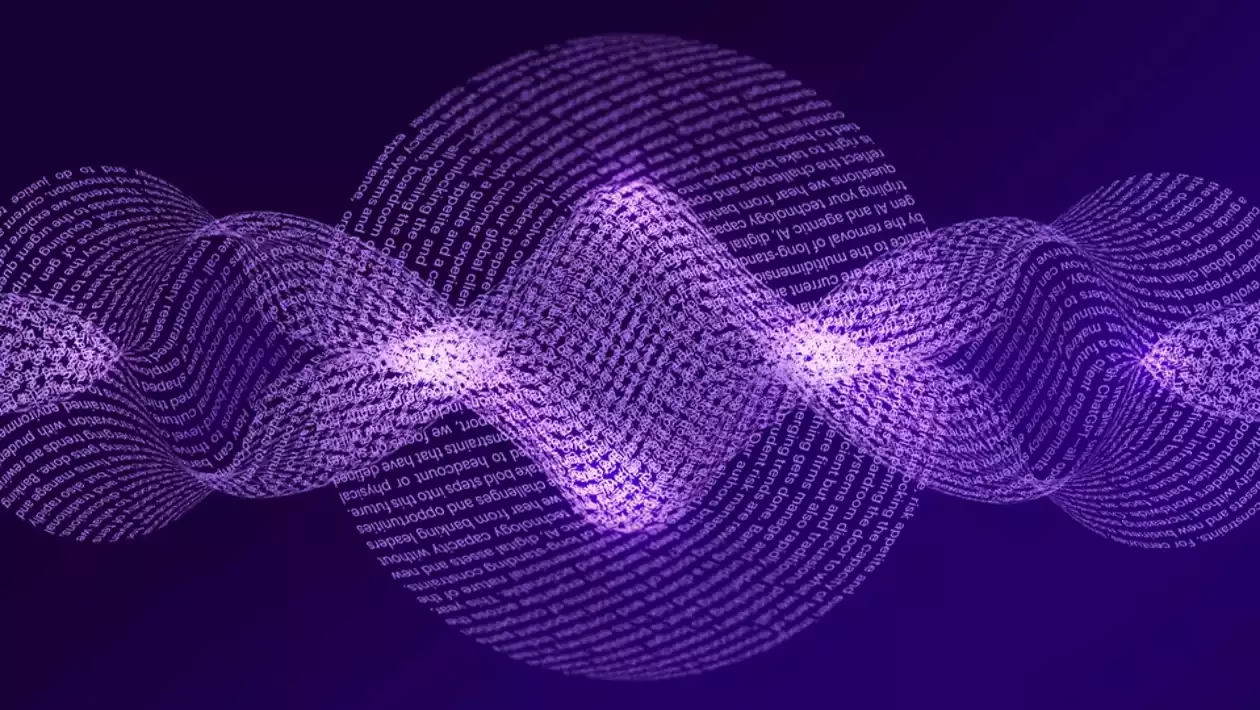
A bright example of such an approach is Accenture “Top Banking Trends for 2026”.
yt_iframe
Expert presentation is combined with moving visual layers. They reveal financial trends and technological changes.
Another example is Infosys AI-first case study videos
yt_iframe
The story is built around a real employee. This is a more human level of the same system. Here, visual elements support the narrative. They show processes, the logic of decisions, and the structure of the system’s operation without distracting attention from the person in the frame.
As a result, corporate interviews with data visualization become a way to explain complex systems through a combination of human experience and visual analytics. The human provides trust, and the graphics shape understanding.
Creative Freedom: Breaking the Reality Barrier
If corporate cases use hybrid video as an explanation tool, then the creative segment is already about something else. It is about expanding reality itself.
In this space, live action ceases to be the final form. It becomes merely a base layer upon which a new logic of perception is superimposed. Through VFX, motion design, 3D integration, and stylized overlay systems. The camera shoots the world, but the final frame is no longer obliged to obey it.
This is exactly where the effect appears when the viewer simultaneously believes in the scene and understands that it is artificially assembled. This is a new language of controlled illusion.
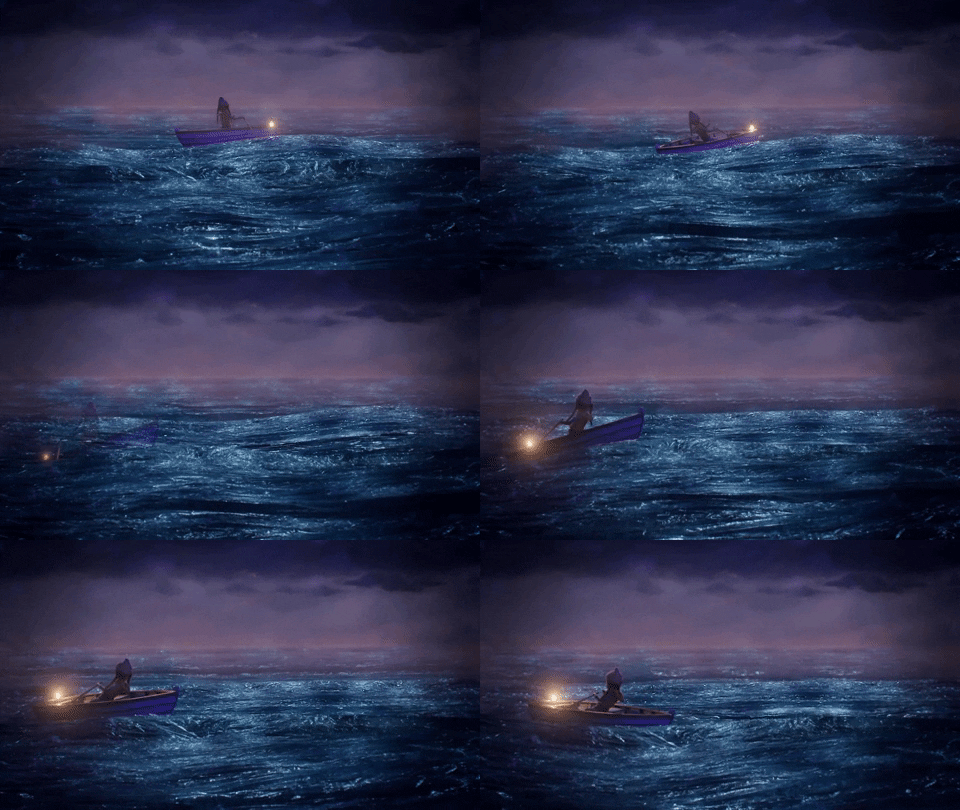
Creative hybrid projects often work according to a simple principle:
The real world gives emotion and weight
Animation adds interpretation
Together they create a third level
A feeling that does not exist either in a documentary or in a fully animated format.
As a result, the boundary between what is shot and what is created becomes aesthetic. And this is exactly the point where hybrid video stops being a technique and becomes a way of thinking about stories.
Conclusion
Hybrid video becomes a way of thinking where reality is assembled anew. From a person, data, and graphics.
We watch pure video less and less often, and more and more often a controlled reality that simultaneously explains and shows.
FAQ
What is hybrid video?
This is a format where live action video is combined with animation, motion graphics, or VFX, creating a single visual system.
How to add animation to live footage?
Through motion tracking, compositing, and overlay graphics that are attached to the movement of the camera or objects in the frame.
Why use mixed media?
To simultaneously convey an emotion (through real video) and explain the complex (through graphics and visualization).
Is hybrid more expensive?
Usually yes, because it requires additional production. Shooting, VFX, animation, and post-processing.