
Contents
What is Isometric Style? Why Is Isometric Style So Popular? Statistics A Showcase of Isometric Style Isometric Animation Isometry in Game Development Isometry in Interior Design Isometry in Marketing and Infographics Pros and Cons of the Isometric Style Visual Appeal and Distinctiveness Technical Complexity in Creation May Limit Dynamism Tools for Creating Isometric Designs A Dose of Creative Inspiration Conclusion16 min read
Isometric style is not just a trend – it’s a true revolution in the world of visual creativity. It combines technical precision with artistic expression, enabling the creation of three-dimensional scenes on a flat surface without using perspective. This approach opens up new horizons in design, animation, and game development, where detail and structure play a crucial role.
Let’s dive deeper into this topic and explore it from every angle.
What is Isometric Style?
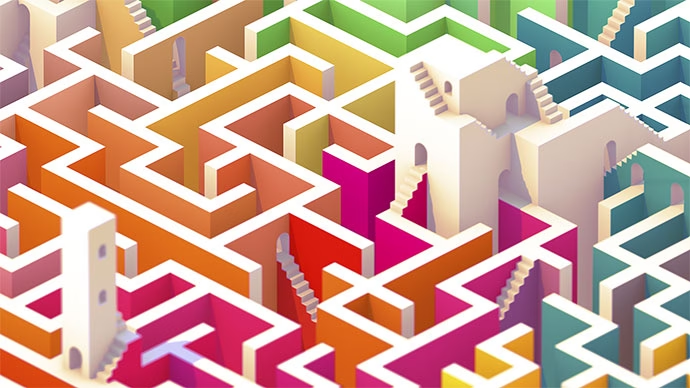
Isometric projection is a type of graphical projection that represents three-dimensional objects in two dimensions, where the three coordinate axes appear equally foreshortened and the angles between any two of them are 120°. This category refers to images drawn or otherwise related to the pseudo-perspective of isometric projection.
Now, let’s put it more simply.
When we look at objects in real life, we see that they have depth, which appears distorted depending on the viewing angle. If we try to illustrate such an object with those distortions in mind, we get a perspective image – it conveys depth and realistically reflects how we perceive things around us.
Isometric imagery works differently – it maintains the same scale and proportions for all parts of the object, regardless of their position relative to the viewer. This means there’s no illusion of depth: all elements appear at the same size.
 .Illustration from the website https://designtalk.club/
Why Is Isometric Style So Popular?
Imagine a flat image coming to life, transforming into a dimensional world where every detail carries its own character and mood. That’s the power of isometric design – a unique style with deep meaning and strong competitive appeal. Its main advantage lies in giving a two-dimensional surface a sense of depth and structure, completely transforming how we perceive a composition.
Isometry unlocks new creative possibilities in fields like graphic and interior design, video game development, and data visualization – and the list goes on.
The isometric style continues to evolve, adapting to new user expectations and industry demands. Its versatility and ability to merge simplicity with depth make it an essential tool in modern design.
Statistics
- According to Depositphotos, the isometric style once again ranks among the top 5 most popular web design trends for 2025.
- 60% of designers in 2023 incorporated isometric elements into their work — a 20% increase compared to 2020. (Source: DesignTalk Club)
- The isometric style is used in over 1,000 popular video games, including hits like Diablo II, SimCity, RollerCoaster Tycoon, as well as new indie developer projects.
- In 2022, around 30% of indie games adopted isometric graphics as their primary style. (Source: IndieDB)
- 55% of modern websites use isometric illustrations to enhance user engagement.
- 80% of users comprehend complex information more effectively when it’s presented through isometric illustrations rather than traditional flat graphics or charts. (Source: Welovebrands)
- There is a noticeable rise in the use of isometry in infographics that visualize statistics and complex concepts: the number of isometric illustrations used has increased by 50% in the past two years. (Source: Infographics Blog)
- Adobe Illustrator remains the most popular tool for creating isometric illustrations: 80% of designers use it in their workflow. (Source: DesignTalk Club)
- Blender is becoming increasingly popular for 3D isometric creation, with a 35% rise in users over the past three years. (Source: Blender Trends)
- 70% of motion designers believe that using 3D isometry in animations significantly boosts user engagement and interest. It creates a deeper sense of realism compared to simple 2D animations. (Source: Siluette)
- 45% of brands on Instagram and Facebook use isometric illustrations to increase engagement, due to their visual appeal and ease of perception.
- Isometric graphics are used in 40% of branded campaigns involving product and service explainer animations. (Source: Behance)
A Showcase of Isometric Style
Isometric Animation
Also known as 2.5D, isometric animation blends the simplicity of 2D graphics with the depth of 3D, creating visually appealing scenes. This style is widely used in explainer videos to effectively convey complex concepts. For instance, Kasra Design produced a series of isometric animations for the Abu Dhabi Department of Culture and Tourism, aimed at training future staff of the National Museum about their responsibilities and work environment.
Explore more at: clapstickmedia.com, kasradesign.com
Platforms like Behance and Dribbble also offer a wide range of isometric animation examples, showcasing the diversity of styles and approaches within the field.
Isometry in Game Development
Isometric perspective has long been a classic in video game development, allowing for the creation of deep and highly detailed worlds. Games like Clash of Clans use isometric graphics to deliver an engaging gaming experience.
(Example: Kevuru Games)
Developers also leverage isometry to design complex game mechanics and visualize multi-layered environments. Guides from 300Mind Studio and TutsPlus provide deep insights into building isometric games – covering perspective, graphics, and gameplay mechanics.
 .Resources: 300Mind, TutsPlus
Isometry in Interior Design
Isometric projection is widely applied in architecture and interior design to produce clear, three-dimensional visualizations on a two-dimensional plane. This helps designers effectively communicate their ideas and ensures better understanding among all project stakeholders.
Tools like Icograms Designer enable users to create impressive isometric interior illustrations with a wide set of customizable icons and an easy-to-use interface.
yt_iframe
Isometry in Marketing and Infographics
Isometric design is gaining popularity in marketing and infographics due to its ability to combine simplicity with depth. It allows for the creation of visually compelling materials that communicate complex information effectively. This style is particularly useful for brands looking to stand out and deliver their message with clarity and impact.
Pros and Cons of the Isometric Style
Visual Appeal and Distinctiveness
Isometric design stands out for its aesthetic finesse, geometric precision, and unique ability to convey complex concepts through simple forms. It creates a visual balance between flat 2D design and the depth of 3D graphics, while remaining easy to process and understand. With its clear angles and uniform scaling, isometry shapes a recognizable style that works well in infographics, UX/UI design, illustrations, and branded content.
Brands often turn to this style to emphasize their modernity, innovation, and tech-oriented identity. Its visual consistency and structural clarity help capture attention quickly and build associations with precision, order, and logic.
Technical Complexity in Creation
Despite appearing simple at first glance, crafting isometric compositions requires a strong understanding of perspective construction, symmetry, and scaling. A designer must not only be proficient with the necessary tools, but also well-versed in creating axes at 30° angles and maintaining precise proportions.
Challenges increase when building complex scenes with many elements or when combining isometry with animation. For example, using movement in isometric space in After Effects demands accurate coordinate calculations and layer synchronization.
May Limit Dynamism
Due to its inherently structured and static nature, isometric style can sometimes create the feeling of a “frozen” space. This can be a drawback for projects that rely on dynamic motion or flexible, expressive storytelling. In animation or narrative-driven content, where emotion plays a key role, isometry may appear overly technical or restrained unless carefully adapted.

Tools for Creating Isometric Designs
Creating isometric graphics requires not only a creative approach but also the right set of technical tools. Depending on the goal – whether it’s a static illustration, interactive interface, or animated scene – different software and resources come into play. Below are the key platforms and supporting tools widely used by design professionals.
1. Adobe Illustrator – The Classic Tool for Vector Isometry
Adobe Illustrator is one of the most popular tools for creating isometric illustrations, especially in 2D design. It offers full control over vector objects, snap-to-grid functionality, and preconfigured isometric plane templates.
Key Features:
Isometric grids via transformation functions (Shear + Rotate)
Additional plugins like VectorScribe or Isometric Illustration Kit
Full integration with other Adobe tools for animation or presentations
2. Figma – For UI/UX and Quick Compositions
While Figma primarily focuses on interface design, it also supports isometry through its active plugin community. It’s perfect for collaborative work, rapid prototyping, and interactive design.
Useful Plugins:
Isometric – transforms any object to a 30° or 45° angle
Angle – allows placing designs in perspective, including isometric
Community Hub templates and object libraries available for quick use
3. Blender – For Advanced 3D Isometry
Blender is a powerful open-source 3D modeling tool, ideal for creating complex isometric scenes. During rendering, you can set the camera to an isometric angle to achieve precise effects.
Capabilities:
Isometric camera setup using orthographic view and 30° angles on X and Y
Realistic lighting and texturing tools
Animation features for interactive or video content
4. Adobe After Effects – Isometric Animation
For animated isometric scenes, After Effects provides vast creative possibilities. Although it doesn’t include a built-in isometric grid, designers use 3D layers and guides to create the right perspective.
Highlights:
Animation of icons, UI elements, or infographics in isometric style
Use of fixed orthographic projection cameras
Support for scripts and plugins such as Ease and Wizz and Motion 3
5. Supporting Resources: Plugins, Templates, and Libraries
In addition to core platforms, several supplemental tools enhance the isometric design workflow:
Envato Elements – ready-made templates, scenes, and object packs
UI8.net – comprehensive UI kits and libraries for web and mobile design
Icons8 – customizable isometric icon library
LottieFiles – animated isometric elements for integration into websites and mobile apps
A Dose of Creative Inspiration
Here’s a curated selection of the most striking and top-rated isometric projects from the past year – a perfect source of inspiration for your next creative endeavor.
Anticipate London 2024 – Coco Loco Studio
Project: Anticipate London 2024
Tools Used: Adobe Illustrator
Description: This project showcases the use of isometric graphics for mapping and planning large-scale events. Coco Loco Studio employed an isometric style to create a detailed city plan of London, highlighting event locations and key sites for the upcoming 2024 Olympic Games.

Sanofi Viz Olympics 2024 – Microsoft Power BI
Project: Sanofi Viz Olympics 2024
Tools Used: Microsoft Power BI
Description: This project was developed for Sanofi, using isometric elements to visualize real-time data during the 2024 Olympic Games. Leveraging Microsoft Power BI, the team created interactive dashboards and visualizations that display countries’ medal standings and provide dynamic analysis of sports performance.
25+ Brilliant Isometric Design Examples 2024 – WPSHOPMART
Project: 25+ Brilliant Isometric Design Examples
Tools Used: Various (Adobe Illustrator, Figma, Blender, etc.)
Description: This compilation showcases over 25 outstanding examples of isometric design, covering categories such as web design, infographics, animation, and graphic illustration. The collection demonstrates how isometry can be applied in commercial projects, branding, and even the creation of 3D cityscapes for games.


Conclusion
Isometric design is more than just a modern trend – it’s a powerful tool for visual communication that merges technical precision with artistic expression. It enables the creation of complex, detailed scenes on a flat surface without perspective distortion, making it indispensable in design, game development, animation, and marketing.
Despite its technical complexity, isometry adds depth, structure, and a contemporary aesthetic to projects, enhancing information clarity and user perception. With a wide range of tools available and growing popularity among designers, this style continues to expand into new fields, inspiring the creation of vibrant, informative visual experiences.